
Short rhythm activities using sound, silence, and breathing, designed to support focus and regulation in group sessions.
Time: 2–3 minutes
Ask everyone to sit comfortably with hands resting on their knees.
Guide them to tap their knees gently while breathing: inhale for four taps, exhale for six.
After a few rounds, encourage them to focus on the smooth rise and fall of their breathing — like a slow wave.
This exercise links rhythmic timing with mindful breathing, helping regulate the nervous system.
It can be done silently or with a soft drum pulse in the background.
Perfect as a grounding start or end to a class, meeting, or wellbeing session.
Time: 3–4 minutes
The facilitator creates a short, slow rhythm using claps or taps — for example, clap-pause-clap-clap.
The group repeats it back, keeping the pace steady and quiet.
After each round, everyone takes one deep breath together before starting the next pattern.
Unlike the more energetic “Call & Echo Breath” from your earlier resource, this version focuses on slow tempo and relaxed concentration.
It encourages deep listening and collective presence — a mindful rhythm exchange that settles attention and connects the group through calm repetition.
Time: 1–2 minutes
Invite the group to create a simple rhythm together — it could be two claps, a tap on the leg, or a single sound repeated in unison.
After a few rounds, pause completely. Hold the silence for a few seconds before beginning again.
Repeat this cycle several times, keeping the pauses calm and intentional.
This activity builds awareness of stillness as part of rhythm. The quiet moments help students notice their breath and feel the shared calm that follows sound.
It’s especially useful for transitions or after high-energy sessions when you want to bring the group back to focus.

Time: 1 minute
Start by asking everyone to place a hand on their chest or thighs.
Invite them to tap together at a slow, steady pace – around one beat per second.
After a few taps, bring attention to the feeling of the pulse – like a collective heartbeat.
Once everyone’s in sync, gently slow the tempo and lower the volume.
Notice how the energy in the room begins to soften and align.
Tip:
Use this when the group feels scattered or over-stimulated.
It helps regulate breathing and creates instant calm.

Time: 2–3 minutes
Begin by clapping a simple pattern — 1, 2, 3, 4.
Encourage everyone to join in. Keep it light and rhythmic.
After a few rounds, start to slow the count.
Each slower beat encourages deeper breathing and quiet focus.
Variation:
Switch to soft finger snaps or gentle taps on the knees.
The quieter it gets, the more the group tunes in.
Tip:
Great for transitions between high-energy and reflective activities.
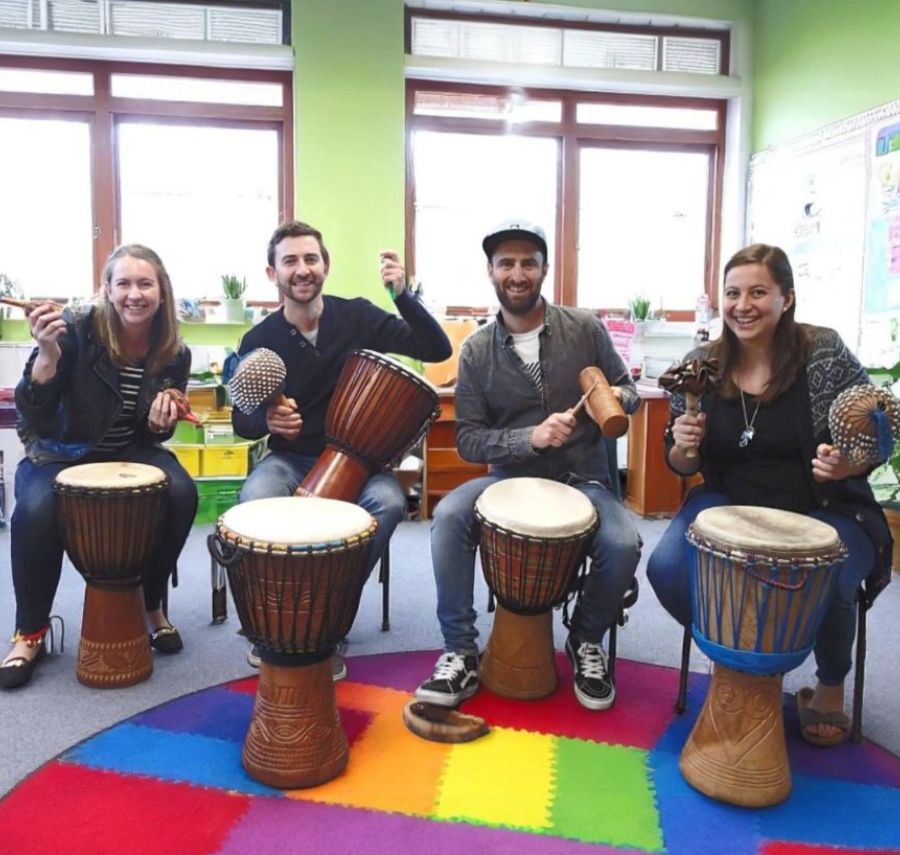
These activities work best when introduced calmly and kept simple.
Short rhythms with clear timing are more effective than complex patterns, especially when a group is overstimulated or distracted.
Pay attention to volume, pace, and your own presence as the facilitator – slowing your movements and voice often has as much impact as the rhythm itself
You don’t need to explain what’s happening in the moment; let the activity do the work, then move on once the room has shifted.
Over time, groups begin to recognise these cues and respond more quickly, making rhythm a reliable tool you can return to whenever the energy needs adjusting.
For more information and booking inquiries, please fill out the details below and we will get in touch.
Or send us an email at [email protected]
We are known for our quick replies
For experienced drumming facilitators, our training offers valuable new perspectives, techniques, and tools to enhance your teaching practice. Even if you’ve completed other programs, Level 1 introduces a unique approach to facilitation that focuses on group dynamics, session structuring, and adapting content for different learning environments. You’ll gain new insights into West African cultural context and practical classroom applications, which can enrich the way you lead your sessions.
We recommend starting with Level 1 because it provides a strong foundation, covering essential themes and methods specific to our training. Many experienced facilitators choose to complete Levels 1 and 2 together for a deeper, more cohesive learning experience.
Facilitator training is a multi-level program designed to build your skills as a drumming educator – covering instrument technique, ensemble facilitation, program design, curriculum alignment, and leadership over time.
Graduates can begin leading sessions after completing Level 1, with additional levels available to deepen their learning.
Professional development workshops are shorter, focused sessions that dive into specific topics or skills (for example, rhythm games, wellbeing through drumming, classroom integration) without the full training pathway.
If you want deep, long-term growth and the ability to lead your own drumming programs, facilitator training is the way to go. If you’re seeking a targeted skill boost or introduction, a PD workshop might suit you better.
Drumming and culture are inseparable. Our facilitator training weaves in the cultural background of West African music so you can appreciate not only how to play, but why the music exists in the way it does.
Throughout the training, we explore the social and cultural roles of music and dance in West Africa – from celebrations and rituals to storytelling and everyday life. You’ll learn how these traditions inform the rhythms and ensemble structures you’ll be teaching.
Understanding the cultural context deepens your connection to the music and helps you share it respectfully and authentically in your own sessions.
Dance is central to West African music – it’s not just an addition but an essential part of the ensemble.
You’ll learn how movement interacts with drumming, exploring the call-and-response between the dancer and drummer.
We look at the cultural role of dance in African communities – from storytelling and celebration to rites of passage – and how to include movement and body percussion in your own sessions.
Drumming supports focus, confidence, and self-expression. It helps students develop emotional regulation, social awareness, and teamwork skills while building confidence and resilience.
The training also links these outcomes with the Australian Curriculum’s wellbeing and arts strands, helping educators use drumming to promote mindfulness and positive classroom energy
You’ll gain hands-on experience in leading groups, managing energy, and maintaining engagement.
The training builds communication, teamwork, and classroom management strategies, helping you confidently guide groups of any size or age.
You’ll also learn how to adapt content for different skill levels and educational settings
The facilitator training aligns with both the Australian Professional Standards for Teachers (AITSL) and the New Zealand Teaching Council’s Code and Standards, covering areas such as curriculum planning, differentiated instruction, and inclusive classroom practice.
Educators can record this training as professional learning towards maintaining accreditation.
We can provide further information on these links to help you secure approval for funding for your registration.
Yes. We offer a range of classroom instrument packs that complement the facilitator training, each designed to suit different age groups, class sizes, and budgets.
Educators receive discounted rates and personalised advice, and we can tailor packs to match your program’s goals and student needs. They’re a great next step for teachers who’ve completed the training and want to bring drumming into their classroom or community setting.
See how our school packs can support your program.
The main instrument is the djembe, a versatile West African hand drum that’s accessible for all levels.
You’ll also work with other core ensemble instruments, including dununs, bells, abnd shakers, learning how each contributes to a complete arrangement.
Each training level explores the ensemble in more depth.
Yes. You can register through the form and choose to pay by invoice.
We’ll reserve your spot, and your place will be confirmed once payment is received.
Yes – you’re welcome to cancel or reschedule if your plans change.
For changes made 7 or more days before the course, you’re entitled to a
full refund or credit towards a future date.
For changes made less than seven days before your booked training, a $75 + GST fee applies to cover admin and preparation costs.
No-shows are non-refundable and non-transferrable.
You’re welcome to send someone else in your place at no extra cost, just let us know with at least 1 day’s notice.

Get in touch with our team for personalised advice. We’re known for our quick replies!
Hit enter to search or ESC to close