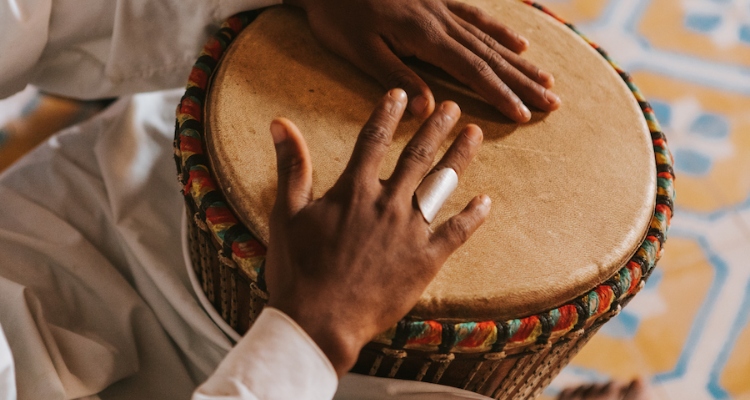
Most people buying a djembe focus on the shell. The wood, the carving, the size.
The djembe skin thickness gets less attention, which is a mistake, because the skin is where the sound actually starts.
It’s the first thing your hand touches. Everything else follows from it.
Putting aside the different types of djembe skins (goat, cow, yearling, calf etc – that’s a discussion for another day), djembe skin thickness is one of the primary factors determining how a drum sounds.
It affects the pitch, sustain, tonal depth, and responsiveness of every note you play.
Getting it right for your drum size, hands, and level changes the experience significantly.
.
What djembe skin thickness actually means
Djembe skin thickness refers to the depth of the goatskin membrane stretched over the drum head.
Thinner skins vibrate faster and more freely, producing brighter, more responsive sounds.
Thicker skins vibrate more slowly, with more resistance, producing warmer, deeper tones with greater tonal complexity.
That difference in vibration is what you hear as the character of the drum. It’s not subtle.

Quick reference: thin, medium, and thick
Thin skins
Sound Character: Bright, fast slap, lighter bass.
Best for: Small djembes (under 11″), beginners, smaller hands.
Medium skins
Sound Character: Balanced tone, clear slap, warm bass.
Best for: Most players, 11–12″ djembes.
Thick skins
Sound Character: Rich, deep tone, complex slap.
Best for: Experienced play
Thin Skins
Thin skins produce a bright, sharp sound with a fast, cutting slap. The tone sits higher in the frequency range and the bass is present but lighter.
These skins are more forgiving on the hands, which makes them a sensible starting point for beginners or players with smaller hands.
They suit smaller djembes and are not recommended for drums that will be tuned to high tension (from a durability perspective).
Medium skins
Medium skins are the most versatile.
The slap is defined without being brittle, the bass is warm, and the tone sits in a balanced range that suits most playing contexts.
This is the most forgiving thickness for players still developing technique and the right starting point if you’re replacing a skin and unsure what to choose.
Thick skins
Thick skins produce the warmest, richest tonal character. “I value the warmer, richer tonal sounds they produce,” says Simon Fraser, who has been sourcing djembe skins directly in Guinea, Mali, and Ivory Coast for over 30 years.
“They can help produce more differentiation between slap and tone when paired with good technique.”
The trade-off is real. Thick skins are harder on the hands and require better technique to extract a clean slap.
They also take significantly more force to tune and sit at higher tension once mounted.
A player who can’t yet produce a consistent slap on a medium skin will find a thick skin discouraging rather than rewarding.
How to assess a skin before it goes on the drum
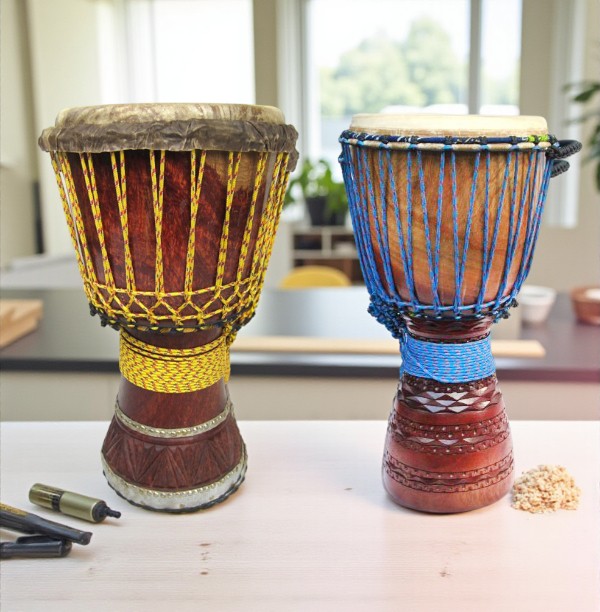
Before a skin ever meets a drum, it’s worth taking time to assess it properly.
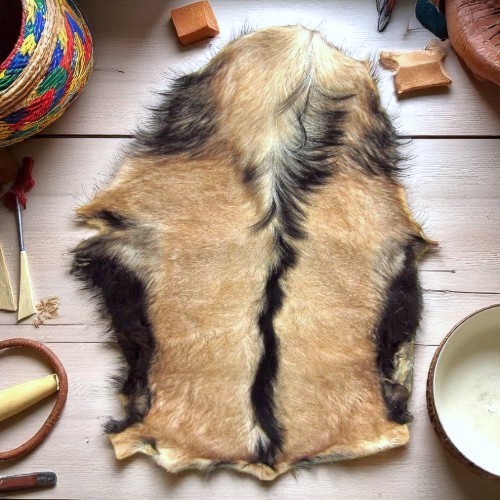
“Firstly, it’s a physical feel of the skin,” Simon explains. “I feel the width across the flank and then down the spine and tail area to look for consistency.
Then I bend the skin and hold it up to the light to check for flaws: insect bites, fatty oil deposits, weak spots.”
The spine deserves particular attention. The thicker ridge running down the centre of a goatskin affects both tuning and tone.
A skin with inconsistent thickness moving away from the spine toward the flanks will vibrate unevenly.
Pulling the verticals slightly less hard near the spine during tuning compensates for this, since the spine sits naturally at a higher pitch than the thinner flanks at the same tension.
Lets talk goats – Where the goat skin comes from changes everything
Not all goatskins behave the same way, and the reason is diet and geography.
West African goats live in more arid conditions and have a lower fat content than Australian goats, which graze on lush pasture and develop thicker, fattier skins
That fat content directly affects how the skin sounds and settles on a drum.
West African skins, particularly from Mali and Guinea, tend to find their sweet spot almost immediately after fitting.
They have a dry, crisp character: the quintessential djembe sound. Australian skins have more elasticity and take longer to play in, often requiring several weeks of gradual tuning to reach their best.
Guinea skins tend toward a sharper, more pronounced slap. Mali skins are known for even thickness and a balanced, full-bodied sound profile.
If a skin is listed as standard goatskin from either country, that is a good sign.
The alchemy of timber, skin, and maker
Thickness alone doesn’t determine the outcome. “There is occasionally a magical alchemy that happens when timber meets skin meets drum-maker,” Simon notes.
“Some lower density timbers can produce hardwood-sounding performance when paired with the right skin.”
This is why the same skin can sound different on two drums of ostensibly identical spec.
The relationship between shell density and skin tension is not linear, and experienced drum-makers develop an instinct for which combinations work.
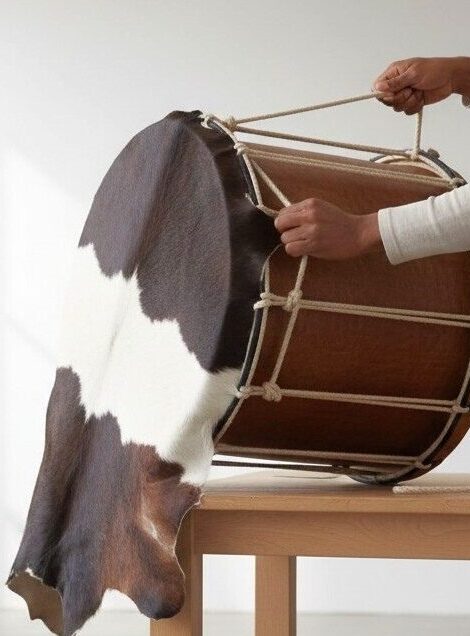
Cowhide on the dundun
On dunduns, the bass drums that anchor a West African ensemble, cowhide is the standard.
Cowhide is two to three times thicker than goatskin and produces the deep, resonant tones the dundun needs to function as rhythmic foundation.
At moderate tension it gives melodic tones with minimal overtone, supporting the djembe lead without competing with it. See our full range of dunun drums if you’re building an ensemble setup.
Choosing the right skin for your level
The most common mistake is choosing a skin based on what someone else plays rather than what suits your own hands and technique.
A novice will not sound the same as a master on identical equipment.
The more useful question is what thickness suits your level now and encourages you to keep playing.
“People often want to sound like someone else, so they choose the same djembe skin thickness as that on another person’s drum,” Simon says.
“The issue is, it’s as much about the person’s hands and technique as it is about the skin.
It’s best to choose a skin that suits your hands and level and encourages you to play more.”
For beginners and players with smaller hands, a thinner skin is more forgiving and rewards consistent practice faster.
For experienced players wanting more tonal depth and willing to work for the slap, a thicker skin offers more range.
Medium suits most situations and is the right place to start if you’re uncertain.
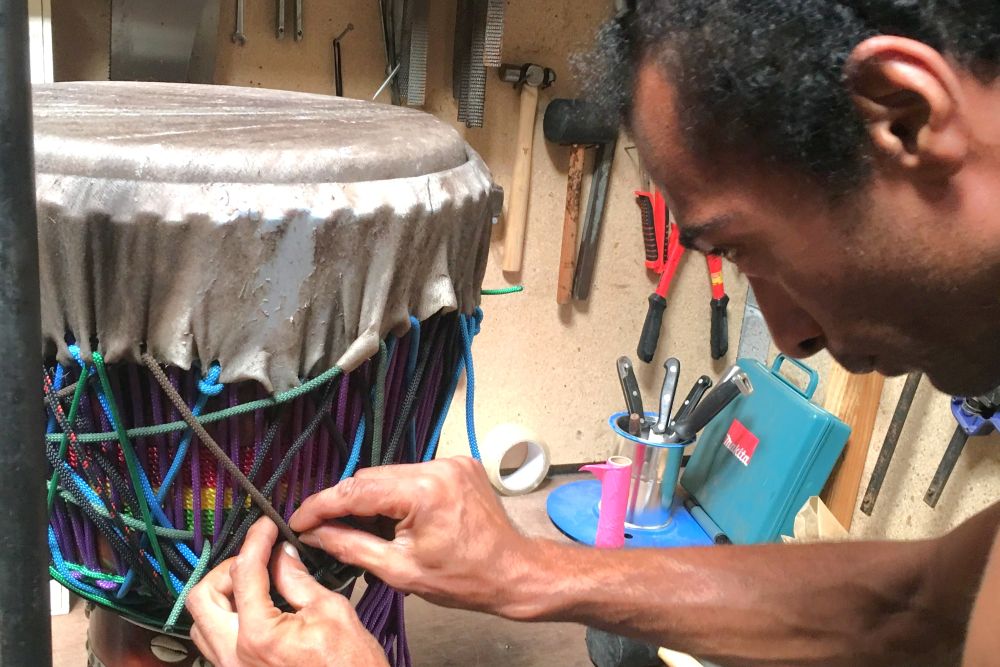
Replacing a skin is also an opportunity to change your drum’s character deliberately.
Going thicker will darken and deepen the sound. Going thinner will brighten it and sharpen the slap.
Browse African Drumming’s full range of djembes to find a drum that matches where you are now.
Common question
Does djembe skin thickness affect how hard the drum is to play?
Yes. Thinner skins are more responsive and require less force to produce a clear tone. Thicker skins need more energy behind each stroke, particularly for the slap. Over a long session the difference in hand fatigue is real.
Does a synthetic skin behave the same way?
Broadly yes.
Thicker synthetic heads produce a fuller, warmer tone and thinner ones a brighter sound, following the same principles as natural hide. The main difference is consistency.
Natural goatskin varies in thickness across the surface, particularly around the spine, which creates subtle tonal variation.
Synthetic skins are uniform, which some players prefer.
Hair-on versus shaved — does it matter?
Some drums may come with a hairy overlap or “collar”.
This is purely aesthetic and does not influence the overall sound profile of the drum.
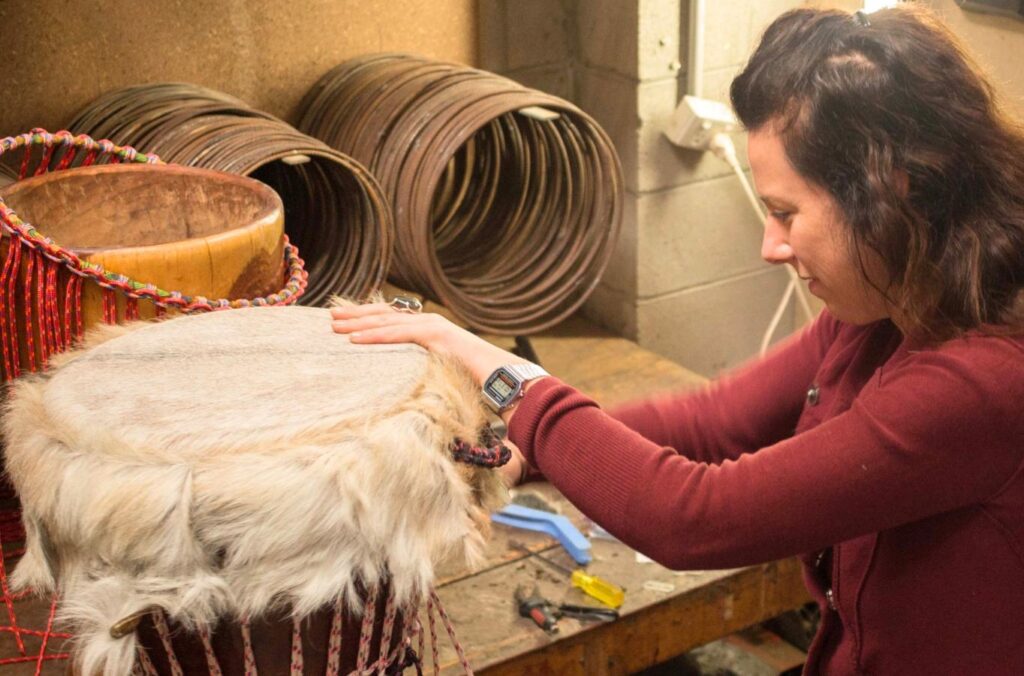
If you’re fitting a skin yourself, shaved or hair free skins are considerably easier to work with.
It is worth noting that some hair free skins may have been processed with salt, lime, or other harsher chemicals, which can change the natural constitution of the skin and effect sound performance, elasticity, and durability.
At African Drumming, all our drum skins are naturally processed, free from harsh chemical treatments, so the skin retains its natural elasticity, strength, and sound.