
If you’ve ever sat in a West African drumming circle and felt like the music was pulling you in two directions at once, you’ve already felt what a polyrhythm does. You just didn’t have a name for it yet.
What Is a Polyrhythm?
At its most basic, a polyrhythm is two or more rhythms played at the same time that don’t line up neatly with each other.
They sit over the same underlying timing, but divide it differently. The tension between those divisions is where the energy lives.
The most common starting point is three against two: three evenly spaced beats played over the same time span as two evenly spaced beats.
Try this: tap your foot steadily.
Now clap three evenly spaced hits over those two taps. That’s a 3 against 2 polyrhythm. It feels slightly off-balance at first. That off-balance feeling is the point.
In West African music, this idea gets taken much further. A traditional djembe ensemble might have three djembes, each playing a different supporting rhythm, three dununs laying down a bass foundation, and a lead djembe improvising over the top.
Every part has its own distinct identity. Every part also serves the whole. It’s not random. There’s a structure holding it together.
The role of the bell in African drumming
In most West African drumming traditions, there’s often a bell pattern running underneath everything else. It doesn’t change. It doesn’t respond. It just keeps time, cycling through the same phrase over and over.
This is your anchor.
A typical bell pattern in 12/8 might sound like: ONE two three FOUR five six ONE two three FOUR five six, with accents falling on beats one and four. Simple on its own. Indispensable once the djembes and dununs layer in around it.
The bell creates a rhythmic reference point that every other player can orient themselves around. It’s what makes interlocking rhythms possible in a live ensemble where players aren’t watching each other constantly.
You find yourself in the music by finding yourself relative to the bell.

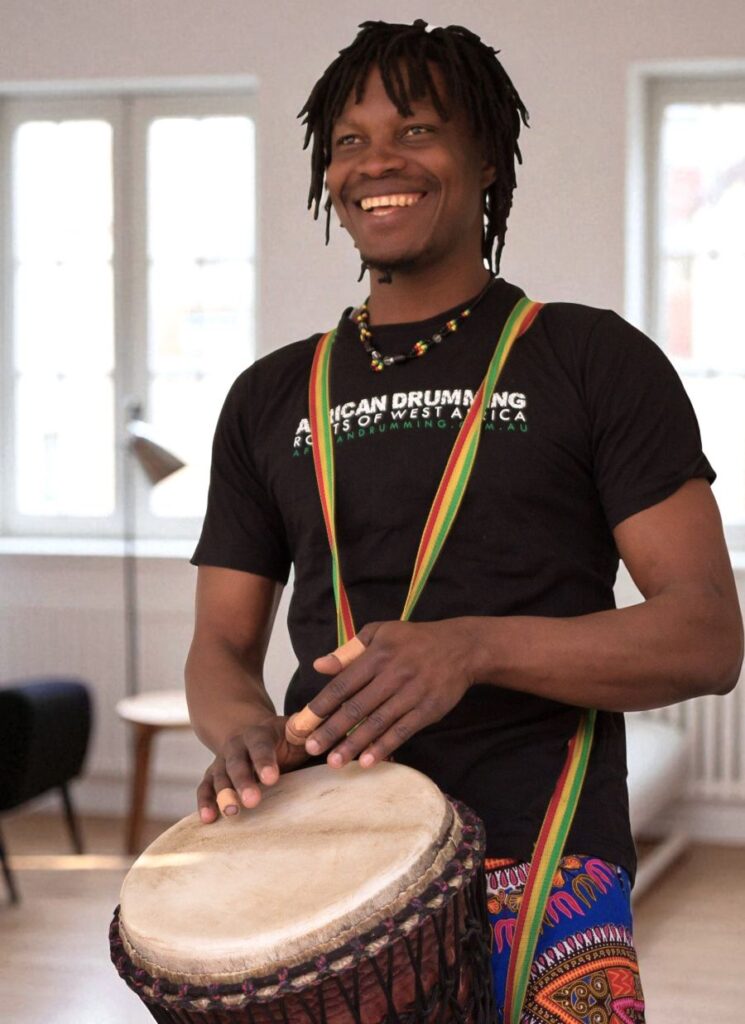
This matters if you’re learning to play. Before you worry about what your hands are doing, ask yourself: can you hear the bell? Can you feel where you are in the cycle? If yes, everything else becomes easier to place.
Rhythmic cycles, not bars
Western music tends to think in bars: count to four, reach the end, start again. West African polyrhythms work differently.
The unit is the cycle, the full phrase length before the pattern repeats. Some cycles are short. Some take several bars to complete.
A single drum part might feel like it starts in the wrong place until it completes its cycle and resolves.
There’s a physical sensation to this, a slight lean forward as the parts that were pulling apart begin to converge, then land together.
That moment of resolution is what drives the music forward. Resist the urge to count in fours. Let the pattern breathe through its full cycle and listen for where it settles back at the beginning.
Layering rhythms in practice: start with two
The simplest way to start understanding polyrhythms through playing is to work with just two parts. Take a basic djembe support rhythm and play it against a simple dunun pattern. Don’t rush to add more.
Listen to how the two parts relate. Where do they land together? Where do they pull apart? That space in between is the groove.
In call and response drumming, this relationship becomes even clearer.
One part states something. Another answers. The conversation between them creates a third implied rhythm that neither player is actually playing.
Think of it like two people clapping different patterns in a room: there’s a third rhythm in the air, made entirely from the gaps.
That implied rhythm is what gets into the body of the people listening and dancing, and it’s why West African music moves people physically in a way that a single drum pattern rarely does.
Cross-rhythm and finding your place in the cycle
One of the most common moments of confusion for people new to African drumming is playing what feels like the wrong beat. You start a pattern, feel confident, and then suddenly you’re not sure if you’re one beat off or perfectly in time.
This is cross-rhythm at work. Your pattern is correct. Your ear has just latched onto a different reference point than the one the ensemble is built around. The fix isn’t to play louder or speed up. It’s to find bell or dun anchor, find the cycle, and trust the pattern.
Simon, our founder who has played and taught West African rhythms professionally for over 30 years, puts it simply: the music tells you where you are if you’re willing to listen to it rather than fight it. That’s easier said than done, but it’s the right orientation.
Why Polyrhythms Matter beyond the drum
Polyrhythmic drumming shapes music well beyond the African continent. Jazz, funk, Afrobeats, and a lot of contemporary electronic music all carry traces of the same structural logic: layering rhythms that create tension against each other, resolving periodically before opening up again.
Steve Reich’s minimalist compositions were directly inspired by time studying Ghanaian drumming. Ginger Baker described hearing African drum music for the first time as genuinely changing the way he understood rhythm.
That influence ran one direction for a long time. Understanding where it came from gives you a different relationship to all of it.
A Simple Way to Start Exploring Polyrhythms Today
If you want to feel polyrhythms rather than just read about them, the fastest route is a class. African drumming workshops are where the theory becomes physical. You stop analysing and start responding, and that’s when the layering of rhythms stops being a concept and becomes something you carry in your hands.

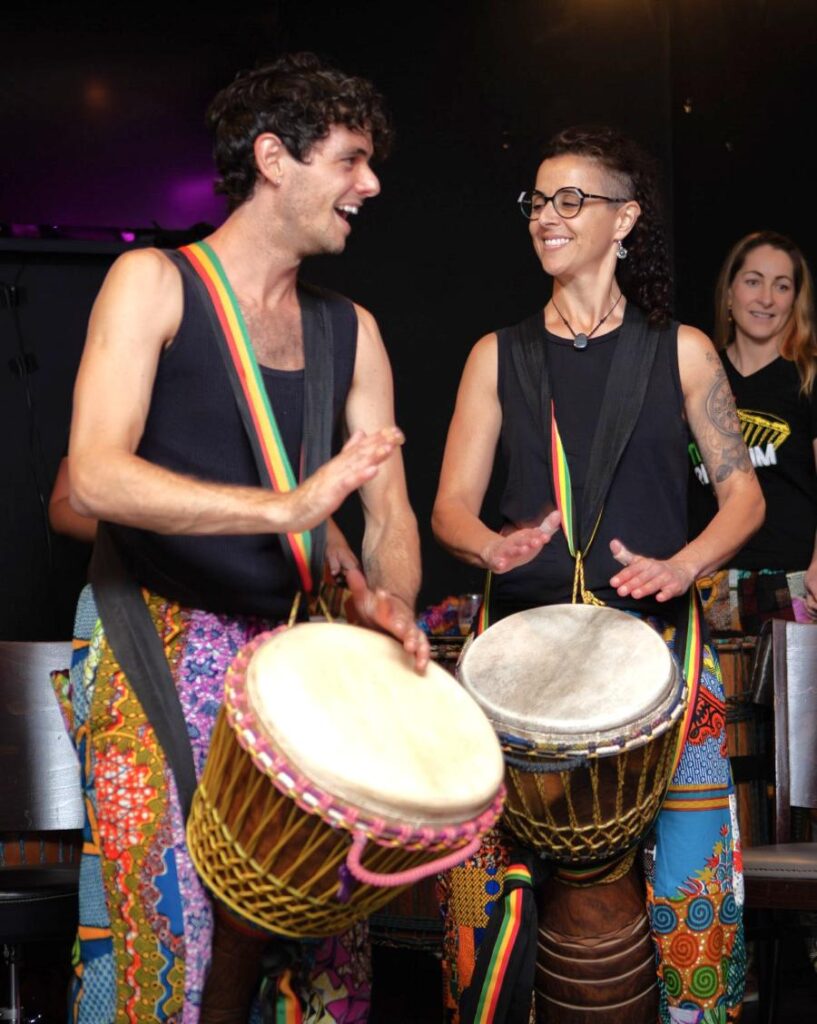
We run regular djembe classes and workshops in Melbourne and online, from beginner sessions through to intermediate and advanced ensemble work, where you’ll spend time playing interlocking djembe rhythms with a full group. If you’re curious, have a look at what’s coming up.
Common questions about Polyrhythms
What’s the difference between polyrhythm and cross-rhythm?
Polyrhythm is the broader idea: multiple rhythms running at the same time.
Cross-rhythm is a specific type, where one rhythm cuts across the main feel of the music, often creating that “am I in the right place?” moment that catches new players off guard.
Why do I lose my place when playing a polyrhythm?
Usually because your ear has locked onto a different reference point than the one the ensemble is built around. The pattern itself is often correct.
Coming back to the bell or the cycle helps you reorient without stopping.
How do you practice polyrhythms on a djembe?
Start with two parts only. Play a steady supporting pattern, then layer a second simple phrase over it.
Keep it slow and listen for where the parts line up and pull apart.
That relationship between two rhythms is the foundation. Everything else builds from there.
