This guide sets out how a West African drumming workshop supports the Early Years Learning Framework and the National Quality Standard, so the session can be planned and documented as part of your educational program.
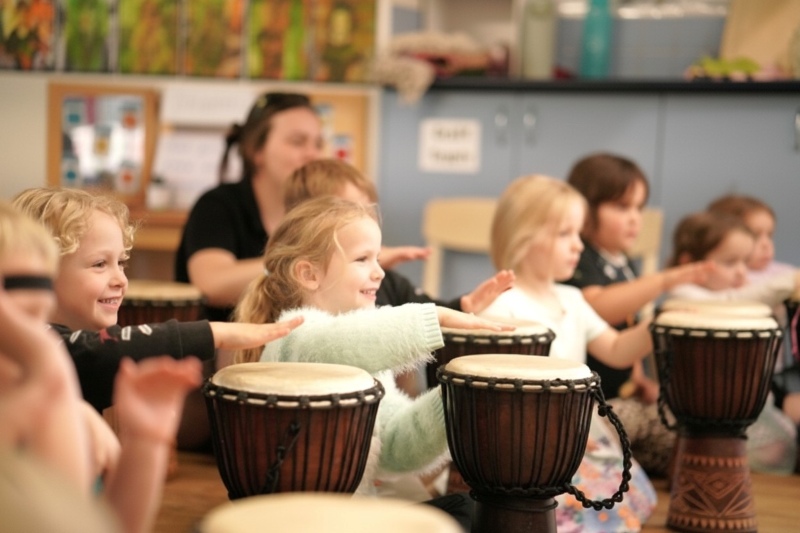
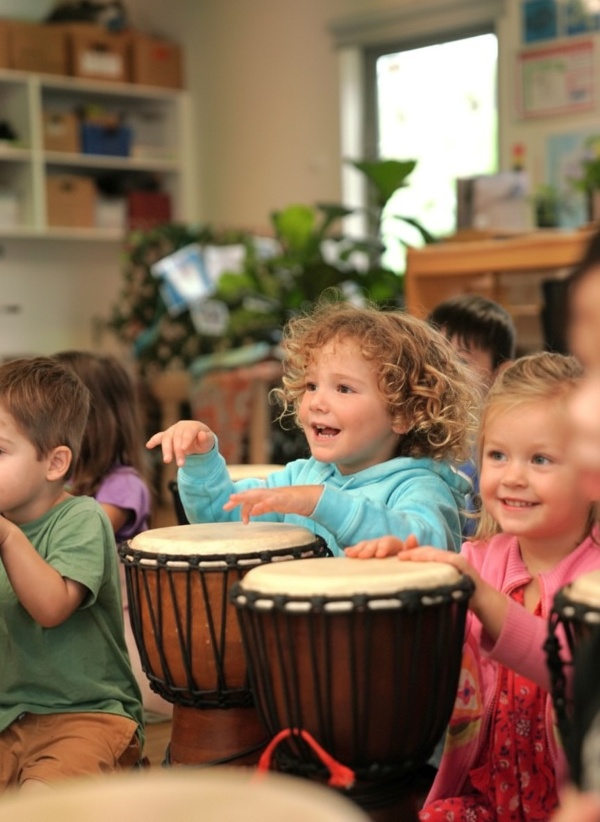
Our kinder incursions introduce children to West African music through hands-on drumming, songs and dance, with every child playing their own djembe.
Sessions are accessible to all ages and abilities, and support creativity, communication, teamwork and healthy development. Children play and learn the rhythms with facilitators of West African heritage, who carry the music and its traditions first-hand.
Sessions normally run for 45 minutes, with shorter sessions for toddlers. We adjust the length, activities and content to suit the age and setting of your group.
Each workshop starts with a short performance and introduction from the facilitator. Children then play their djembes, learning African rhythms through musical games and group play. Singing and dancing are part of the session, and there is time for questions.
Alongside our standard kinder drumming workshops, we offer a range of other formats:
Our workshops support outcomes across the Early Years Learning Framework (EYLF V2.0), the national framework for early childhood education. Through drumming, song and dance, children build confidence, take part in a group, learn about cultures beyond their own, and express themselves.
Some states use companion frameworks alongside the EYLF, including the Victorian Early Years Learning and Development Framework (VEYLDF), the Queensland Kindergarten Learning Guideline (QKLG) and the Kindergarten Curriculum Guidelines in Western Australia. The alignment below references the EYLF learning outcomes that underpin these frameworks.
The workshops also support the National Quality Standard, in particular Quality Area 1: Educational Program and Practice. The session is built around children’s active participation and learning, contributes to a program informed by the EYLF, and offers an inclusive experience that every child can take part in regardless of age or ability.
They also touch on Quality Area 5: Relationships with Children, through positive group interaction and turn-taking, and Quality Area 6: Collaborative Partnerships, when families join a shared session.
The alignment below references the EYLF learning outcomes that underpin these frameworks.

| EYLF V2.0 Learning Outcome | How the workshop supports it |
|---|---|
| Outcome 1: Strong sense of identity |
Children build confidence as they take part in the group and play their own djembe. Drumming offers every child a way to contribute and be heard, whatever their age or ability. |
| Outcome 2: Connected with and contribute to their world |
Children take part in West African musical traditions first-hand and learn where the rhythms and instruments come from. The workshop encourages respect for different cultures and an understanding that people express themselves in different ways around the world. |
| Outcome 3: Strong sense of wellbeing |
Rhythm-based play supports emotional regulation and wellbeing. Children participate actively, develop coordination and engage in physical activity through drumming, singing and dance. |
| Outcome 4: Confident and involved learners |
Children explore rhythm, pattern and call and response through hands-on play and musical games, developing concentration, coordination and curiosity. |
| Outcome 5: Effective communicators |
Drumming, singing and call and response give children a non-verbal way to express themselves and respond to others, supporting early language, listening and turn-taking. |

A West African drumming workshop supports outcomes across the EYLF, so it can be planned and documented as part of your learning program rather than treated as a one-off extra.
Because it connects to the framework your service already works from, educators can record it as an intentional learning experience, which is often what supports the case for running and funding it.
Are your facilitators insured?
Yes. African Drumming holds public liability insurance. All facilitators hold current Working With Children checks.
Our kinder facilitators are of West African heritage and are experienced performers
and educators in West African music.
We’re known for our quick replies
Hit enter to search or ESC to close