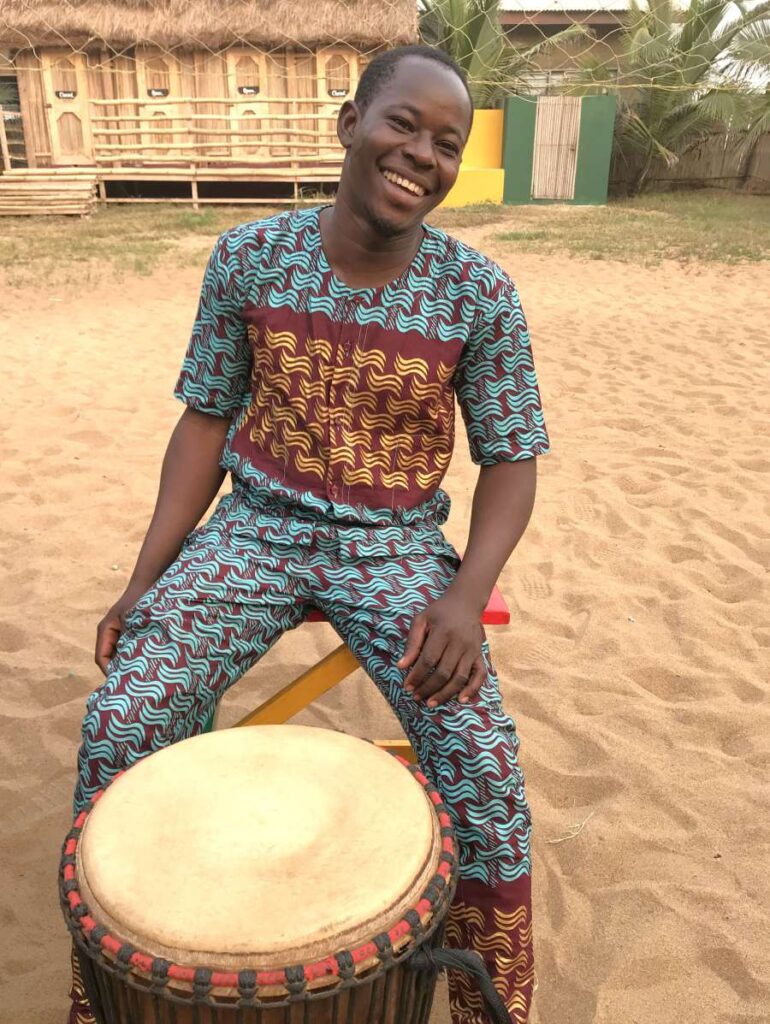
Choosing your first djembe can feel like a lot, but it mostly comes down to two things: a size that fits you, and a sound you like. This guide walks you through how to choose a djembe, from those two basics to the timbers and skins behind the choice.
How to pick the right djembe size and sound
Size and sound are the two anchors.
Timber, head diameter and construction all follow from them.
Getting the size right.
When you sit to play, the rim should sit a couple of inches above your thigh, not level with your leg, and not more than four inches above it.
Standard adult djembes are 59cm to 66cm tall, so your height is the starting point (see the chart below).
Your chair is also a factor: a taller chair needs a taller drum.
Drum head size plays in here as well: Adult drum heads start at around 11.5 inches, and most players land between 11.5 and 14 inches.
A wider head gives more room, more bass & sustain, and more surface for larger hands; a narrower head suits smaller hands, since the playing area sits closer together.
Getting the sound you want
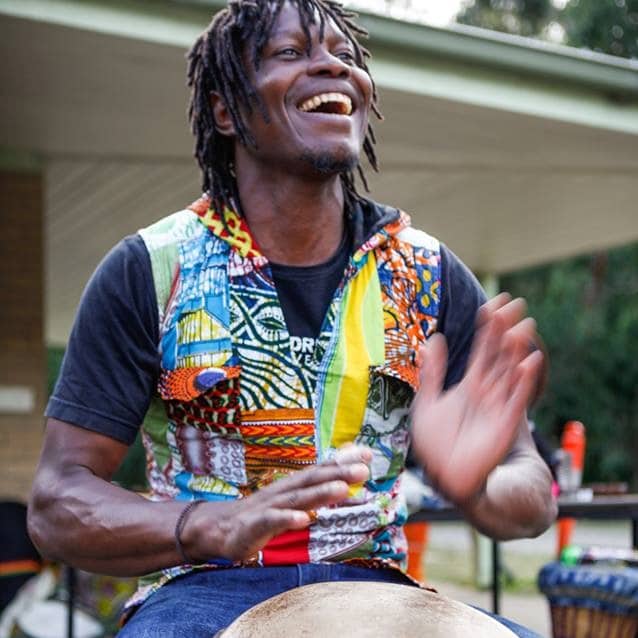
Three things shape the tone: timber (type and shape), skin, and head size.
Dense hardwoods like lenke and Khadi give a wider tonal range and stronger projection.
Medium-density timbers like Twenaboa, used on the Ghana drums, give a strong low end at a lower price.
Skin thickness changes the feel: thinner skins respond faster and are kinder on the hands, which is why they suit beginners, while thicker skins have more complex tones, challenge technique and suit players with more exprience.
A bigger head leans toward more bass and sustain, a smaller one toward a tighter, higher slap.
what makes a good djembe shell
A good djembe shell is carved from a single piece of timber, not glued sections.
The bearing edge, the rim where your hand strikes, should be smooth and even, and the carving clean rather than rough or rushed.
Each of our djembes is presented online with detailed photos and a video, so you can see the shell and finish before choosing, and every drum is checked and tuned before it ships.
Many drums also have a rubber tread around the base, which cushions the drum and stops it from slipping while you play.
Hearing the drum before you choose
Sound is personal, so every djembe on our site comes with a video where you can hear its bass, tone, and slap.
If you’re not sure where to start, send us a few details and we’ll put together personalised video suggestions of drums that we recommend for you.
Watch Simon & Al as they walk you through our djembe range, from the entry-level Ghana and Indo drums to the Guinean hardwood Master series
Common first-time djembe mistakes
Over the decades we’ve helped thousands of people find their djembe, the same two mistakes keep coming up.
The first is size: buying a drum that’s too short, too tall, or too heavy to play comfortably.
Use the height guide below, and don’t choose a djembe on looks alone.
The second is skin: picking a skin that doesn’t match the hands playing it.
A thick cow skin can sound great under an experienced player, but it’s hard work for a beginner, who plays better on a thinner goat skin that responds with less effort.
Djembe height guide
- 155cm to 163cm tall: a 59cm to 61cm djembe
- 164cm to 175cm tall: a 61cm to 63cm djembe
- 176cm to 185cm tall: a 63cm to 66cm djembe
- 186cm or taller: a 67cm djembe or taller
This is a guide only. Other factors matter too, like the chair you play on. If you sit on a tall chair, you’ll likely want a taller drum.
Djembes for Kids & Teenagers
2 to 4 years: the Mini Djembe
4 to 12 years: the Junior Djembe
10 to 14 years: the All Rounder or a 10″ Ghana Series
12 years and over: the Classic or a shorter Ghana Series drum (see the Teen Smasher Pack)
14 years and over: the Classic Plus or a Ghana Series drum (see the Afro Starter Pack)
Young drummers grow fast, so a drum they can grow into is often the better buy.

Our Djembe range
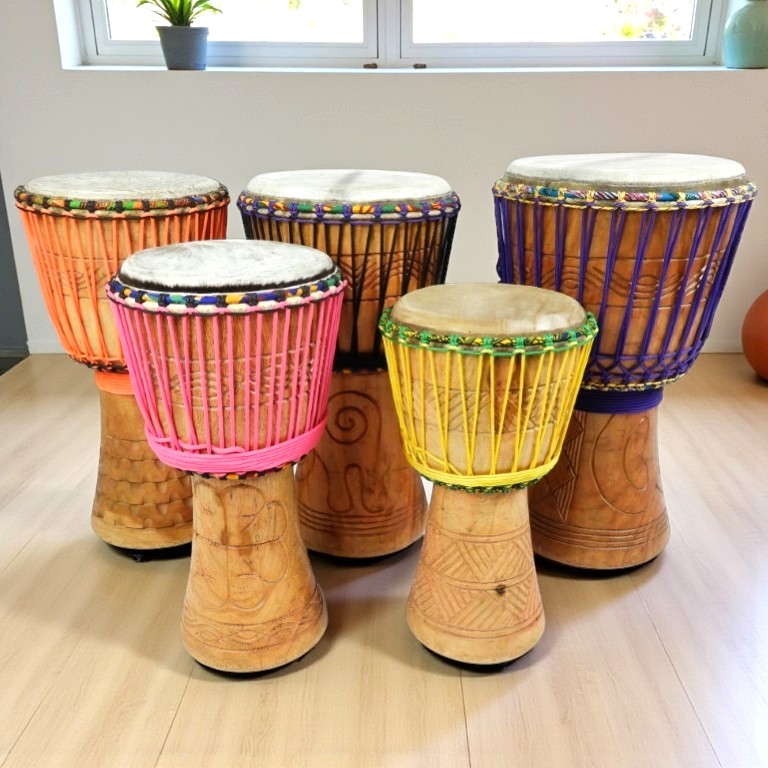
Ghana djembes
Our most popular range, and the usual starting point for getting a first djembe.
Carved in West Africa from medium-density Twenaboa, with a crisp top and a deep low end.
They’re light to carry, come in head sizes from 10″ to 15″, and feature both traditional and contemporary carving.
The most affordable way into a West African djembe, and the usual first drum for players who want an authentic djembe, hand-carved in West Africa
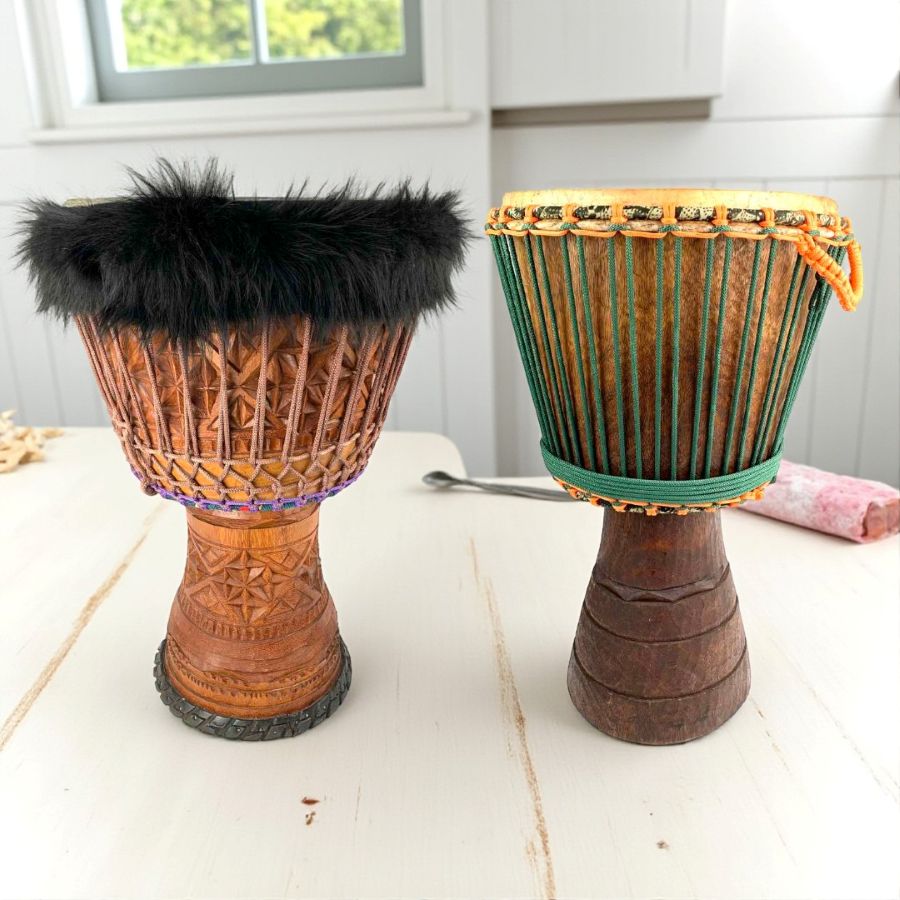
Primo djembes
The step up from the Ghana range into West African hardwood: Djembes from denser timbers with more projection, complex tones and a fuller low end.
Extra work goes into the playing edges and the outer shell, so they play easily and hold a high finish.
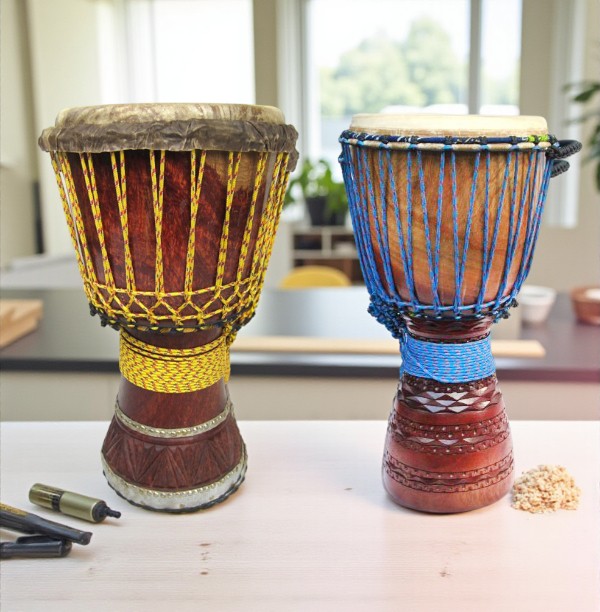
Timbers in the primo range include dense Lenke, Djala, Dougarra and Khadi, plus golden-toned Melina and Iroko.
Master djembes
Our top African hardwood djembes.
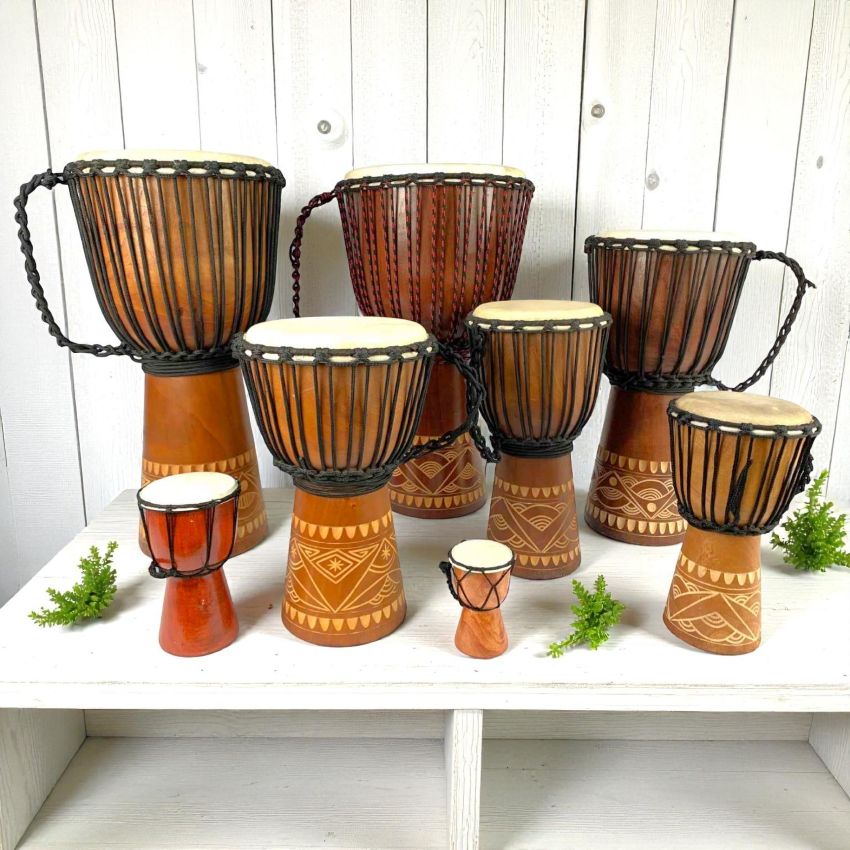
We hand-pick the most symmetrical and unblemished shells from master carvers across Guinea, Mali, Burkina Faso and the Ivory Coast, in premium hardwoods like Khadi, Lenke, Dougarra, Numu and Djala.
The shells are carved almost entirely from heartwood, the dense inner core of the timber, which gives them their tonal range, and each is skinned and finished in Melbourne with the hide balanced to the drum.
Extra time goes into sanding, oiling and polishing the shell. The range covers soloist drums and accompaniment drums, for serious players wanting perfection in sound and aesthetic.
Indo djembes
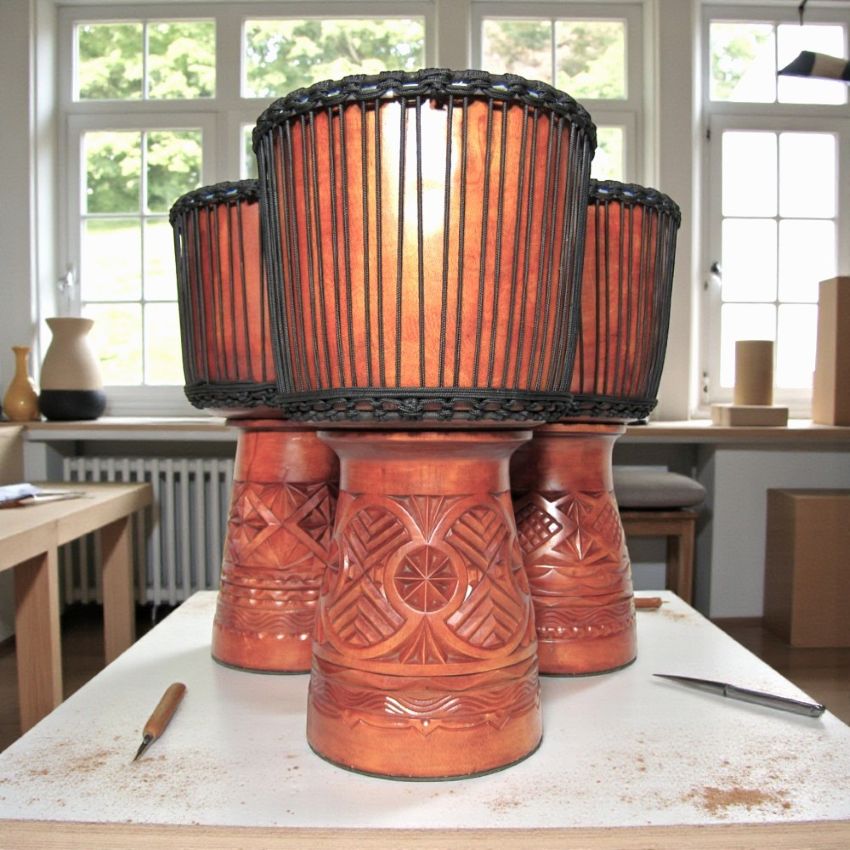
Our most affordable range, made by our team in Indonesia, in sizes for kids to adults.
The djembes are carved from sustainably sourced local mahogany and topped with quality goat skins. The skins aren’t irradiated or chemically treated, so they keep their natural oils and durability.
We work closely with the makers to keep every drum consistent, for a dependable feel and a full, responsive sound at home, at workshops, and in school programs. The 60cm djembe is the smallest and most affordable adult size, and a popular pick for shorter players.
Vegan djembes
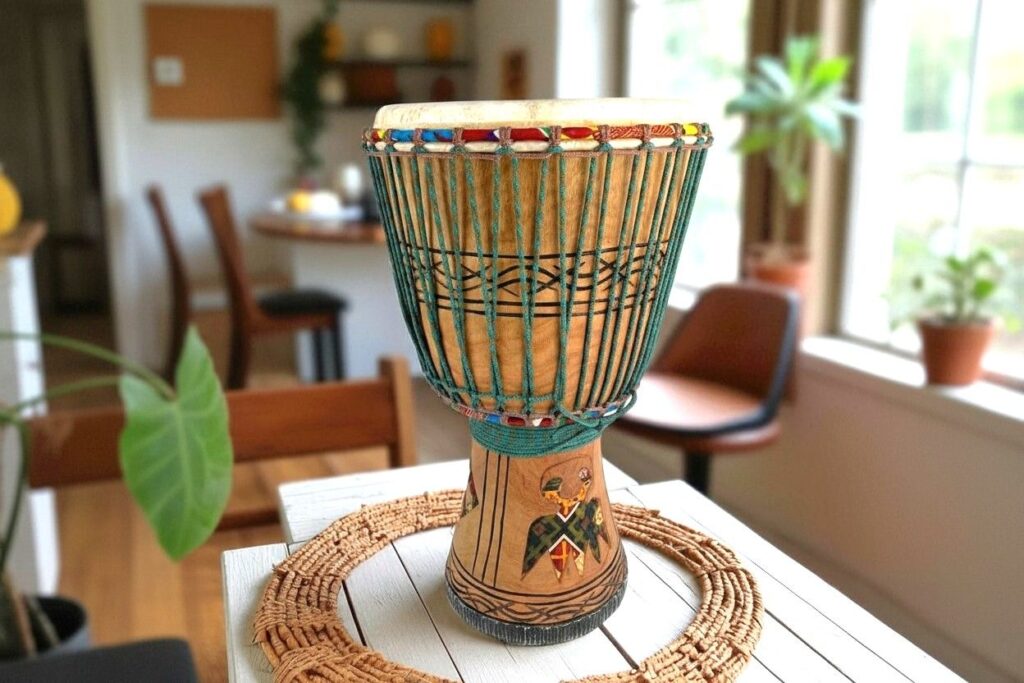
Djembes built without animal products, using durable synthetic heads that hold their tuning as the weather shifts.
They stay consistent in any climate and are easy to look after.
The sound has a clear top and a full bass with plenty of projection, which suits players who spend time outdoors. Strong shells, hand-finished.
Custom made djembes
Build a drum to your own spec.
Choose the timber shell, the skin or a vegan head, rope colours and finish, and we will shape the drum to your height, playing style, and sound preference.
which djembe suits your level?
First djembe (beginner)
A Ghana series drum is the most popular first choice: carved in West Africa from Twenaboa, light to carry, with a strong low end at an entry-level price.
If budget leads, the Indo range is the most affordable adult option, made from mahogany, with the 60cm djembe as the smallest adult size.
Either way, start on a medium to thin goat skin, which responds with less effort and is kinder on the hands.
Ready to move up (intermediate)
When you want more projection and a wider tonal range, step up to a West African hardwood drum.
The Primo series brings dense timbers like Lenke and Djala with balanced sounds, distinct separation between tone and slap, and a larger head that adds volume and bass.
Advanced or performing level
For soloist and accompaniment work, the Master series is our top African hardwood range: hand-picked shells in premium hardwoods, skinned and finished in Melbourne.
This is where you choose a drum for its voice in an ensemble.
A true drum for life.

Get a personal djembe recommendation
We’ll help you find the right djembe. Tell us a bit about you and we’ll pick a few and send you a video of each.
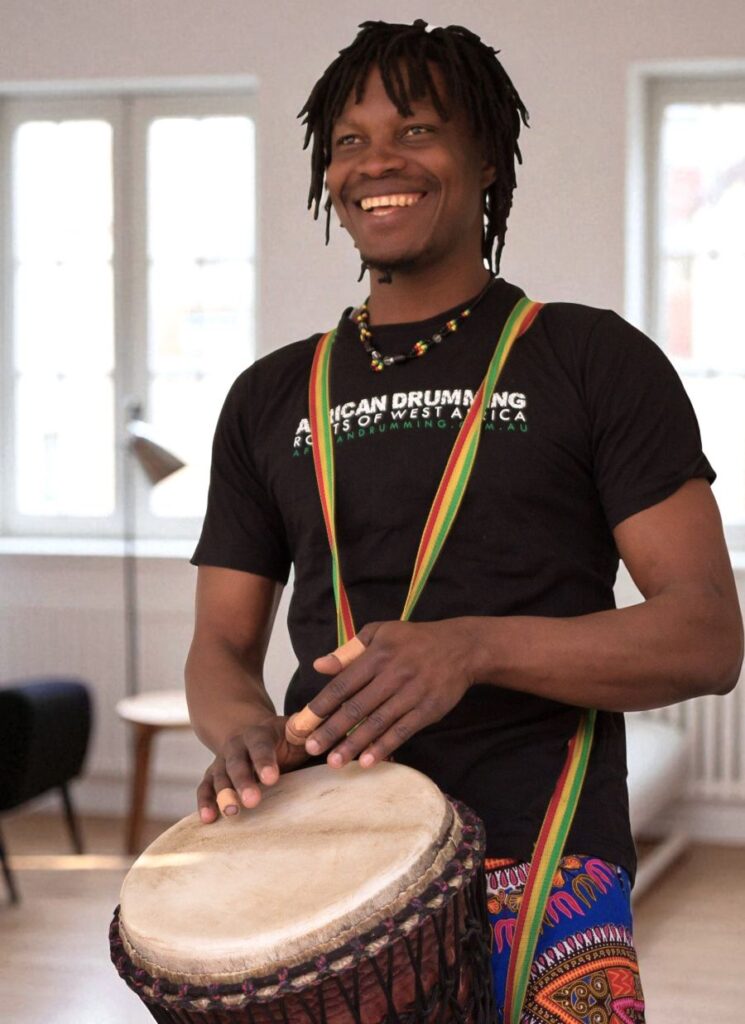
Where the djembe comes from
The djembe is at the heart of traditional Mande culture in West Africa. The name is often translated as a call for everyone to gather together in peace, and the drum has carried music and dance through generations of Mande life.
It plays as a solo or a supporting instrument, usually alongside the bass drums called dunun (often shortened to duns). The dunun carry the rhythmic and melodic frame, and the djembe plays over the top.
Their interlocking parts build the layered sound of traditional West African drumming.
Why African Drumming
We’ve sourced, built, and tuned djembes since 1998, travelling to West Africa regularly to select drums directly from master carvers in Ghana, Mali, Ivory Coast, Burkina Faso, and Guinea.
Our Burkina shells come from master carver Yecou, who sources his timber from the Banfora region of southwest Burkina Faso. Our timbers are non-endangered and, where possible, come from managed plantations.
Every drum is tuned in Australia before it ships, set to the right pitch for where it’s going, and tuned or de-tuned for the climate at its destination. We rope each drum with a low-stretch rope so the tuning holds. Djembes are covered by our 5-month graduated warranty, and the shells by a lifetime structural warranty.
For every African djembe sold, we plant and nurture a hardwood tree in Ghana, through our forest-regeneration partnership with the Ghanaian NGO Denyigba Lorlor. On the Indo range, 5% of each drum’s value supports the East Java Plant a Tree Program in Indonesia.
About the author
This guide was written with Simon Fraser, Founder and CEO of African Drumming, who has performed, recorded, and taught djembe throughout West Africa, Europe and Australia since the 1990s.
FAQs
What does your djembe warranty cover?
Djembe shells are covered by a lifetime structural warranty under normal use.
The skin is covered by a 5-month graduated warranty for premature issues: full repair cover in the first month, then part cover through to five months.
Natural skins vary, and a hidden flaw usually shows within five months, which is why the warranty runs to that point.
Damage from misuse or accidents isn’t covered.
See the full detail on our drum warranty page.
How long does a djembe skin last?
A djembe skin is a natural material, so its life varies: some last several months, others last years, depending on how hard and how often the drum is played, the climate, and how well it’s looked after.
When a skin does wear out or split, our Melbourne studio can reskin the drum, extending your djembe’s life for years more.
How do you tune a djembe?
A djembe is rope-tuned using the Mali weave technique: knots are woven into the vertical ropes, and each knot raises the tension on the skin and lifts the pitch.
Your drum arrives tuned and ready to play, set to the right pitch for the climate it’s headed to, with a care and tuning guide included.
Every African djembe comes with free lifetime tuning at our Melbourne studio, so you can bring it back whenever it it needs a tune
How do I care for my djembe?
Djembes are low-maintenance, but the skin is a natural hide, so a few habits go a long way.
Play with your hands, not sticks.
Keep drinks, food, and sharp objects off the head.
Keep the drum out of extended periods of direct sun, and never allow any rain or moisture to hit the drum head.
Heat and humidity are the main risks – extreme weather changes can make the skin contract and dilate, and can cause the skin to split.
Don’t leave your djembe in a hot unventilated space (room, closet, car etc). Drum bags are great if they are not acting as a furnace for your drum. They can protect the drum from extreme weather shifts, but if left unattended they will eventually heat up to their ambient surrounds too.
Don’t leave your drum standing upright in the scorching sun for too long.
In Africa, when drummers finish playing, they often rest their djembe on its side to let air move through the shell. This helps ventilate and cool the drum head.
Playing the drum is all the conditioning the skin needs, the natural oils from your hands do the work, and other conditioners can rot the hide.
Are African Drumming's djembes sustainably made?
The timbers are non-endangered and, where possible, come from managed plantations.
Our mahogany comes from Government sanctioned sustainably sourced plantations.
For every African djembe sold, a hardwood tree is planted and nurtured in Ghana through a forest-regeneration partnership with the NGO Denyigba Lorlor, and 5% of each Indo drum’s value supports the East Java Plant a Tree Program in Indonesia.
Our skins aren’t irradiated or chemically treated, so they keep their natural oils.
How is a djembe played?
A djembe is played with bare hands, built around three sounds: bass from the centre of the head, tone closer to the edge, and a sharper slap, also closer to the edge. Learning to play those three distinctly is the core of djembe technique.
In West African music the djembe plays as a solo or supporting voice over the dunun bass drums.
Our djembe classes walk you through all three sounds and more, from technique and dexterity to ensemble playing, and run in Melbourne and online.